Guides · 13 min read
The YouTube algorithm in 2026: how it picks videos
The YouTube algorithm is the system that picks which videos each viewer sees on Home, next to other videos in Suggested, and in search results. YouTube says it doesn't push your video out to people. It pulls the videos each viewer is most likely to watch and be satisfied with, using what they watch, skip, search for and tell YouTube.
Most articles on the YouTube algorithm in 2026 quote other blogs. Everything here about how it works comes from YouTube itself: its Help pages, its official blog and the Creator Insider channel, where YouTube's own staff answer creators' questions. I've linked every source. Then I'll show you what that means for a business channel, with my own numbers and real videos from lawyers, CFOs and brokers that are still pulling in viewers years after they went up.
What is the YouTube algorithm?
The YouTube algorithm is a recommendation system that ranks videos for each viewer, one person at a time, rather than deciding who should see each video. YouTube's own performance FAQ puts it plainly: the system "doesn't promote videos to your audience but rather finds videos for your audience when they visit YouTube."
Todd Beaupré, who leads growth and discovery at YouTube, explained it the same way in a Creator Insider interview in January 2025. Creators ask why YouTube isn't pushing their video out, he said, but "it isn't so much about pushing it out as much as it's pulling" for each viewer. YouTube sometimes describes it as "automating word of mouth": it looks at what viewers like you enjoyed and recommends that to you.
According to that same FAQ, the system pays attention to:
- what viewers watch
- what they don't watch
- what they search for
- likes and dislikes
- "Not interested" feedback
So think of "the algorithm" as millions of individual rankings, one per viewer. Your video has to be the best option for some of them. That's why YouTube's advice to creators is to "focus on knowing your audience", not on the system.
How does the YouTube algorithm work in 2026?
The YouTube algorithm works by learning whether people choose to watch a video, how much of it they watch, and whether they were satisfied, then using that to rank it for similar viewers. There's no single number behind it. When creators ask whether it's click-through rate or watch time, Beaupré's answer was that "there's no single answer to that question", because different signals matter more in different contexts.
Here's what YouTube has said about each signal, and where:
| Signal | What YouTube says | Source |
|---|---|---|
| Clicks | "Clicking on a video provides a strong indication that you will also find it satisfying" | YouTube Official Blog |
| Watch time | Used in both forms: relative watch time matters more for short videos, absolute watch time for longer ones | Performance FAQ |
| Satisfaction surveys | Viewers rate videos from one to five stars, and only four or five stars count as "valued watchtime" | YouTube Official Blog |
| Likes, dislikes, shares | "Some of the hundreds of signals" used for ranking | Performance FAQ |
| Not interested | A signal for what not to recommend | Performance FAQ |
| Context | Time of day and device, so you can see different results on your TV and your phone | Creator Insider |
The satisfaction part is the one most creators miss. Cristos Goodrow, YouTube's VP of Engineering, wrote that YouTube learned in 2011 that a click doesn't mean someone actually watched, so it added watch time in 2012. Then it learned that not all watch time is equal, so it started asking viewers directly. YouTube's How YouTube Works site says recommendations use viewing behaviour, likes, dislikes, subscriptions and "feedback, including from satisfaction surveys". Beaupré said YouTube collects "millions of responses" to those surveys and feeds them straight into the system.
The other change worth knowing is under the hood. In the same 2025 interview, Beaupré said YouTube has applied large language model technology to recommendations, so the system can understand what a video is actually about in much more detail. For you, that means the topic and the way you cover it matter more than any keyword trick.
Find the videos your buyers already watch
Find my winning videosSearch, browse or suggested: where do your views come from?
Your views come from three main places, and YouTube ranks each one differently. YouTube search matches your video to what someone typed. Browse features (mostly Home) and Suggested videos rank it on how well it has satisfied similar viewers. You can see the split for any video in the traffic sources report in YouTube Studio.
| Traffic source | What it covers | What YouTube says decides it |
|---|---|---|
| YouTube search | Views from YouTube search results | How well the title, description and video content match the search, and which videos drive the most engagement for it |
| Browse features | Home, subscriptions, Watch Later and other browsing features | How well the video has interested and satisfied similar viewers, plus each viewer's watch and search history |
| Suggested videos | Suggestions next to or after other videos, and links in video descriptions | The videos a viewer is most likely to watch next, often related to the current one |
| Shorts | The Shorts vertical feed | A separate swiping feed, covered further down |
Two lines from YouTube's FAQ are worth reading twice. On search: "Search results are not a list of the most-viewed videos for a given search." And on Home, it shows videos from subscriptions alongside "videos watched by similar viewers and new videos". So a small channel can win in both places. It just has to be the best match.
For a business, YouTube search traffic is the most predictable kind. The person searching already has the problem you solve, and the search keeps happening every day. Browse and suggested views can be much bigger, but they come in waves. YouTube's How YouTube search works page says search ranks on relevance, engagement and quality, and I've covered that side in detail in YouTube SEO in 2026.
Why do some videos keep growing for years?
Some videos keep growing because the system never stops testing them. In a Creator Insider interview from September 2026, Beaupré said that while a lot of videos peak on their first day, "a lot of videos also get the majority of their views, you know, a month or or later if it's evergreen content." YouTube isn't going to stop trying to find viewers who'd be interested.
YouTube's FAQ gives four reasons an old video can suddenly take off:
- The topic is getting more popular.
- New viewers have found your channel and are binge-watching older videos.
- More viewers are choosing to watch it when it's recommended.
- You released a new video in a series, so viewers went back for the earlier ones.
Here's what that looks like on one of mine. My Google Search Console tutorial for SEOSpace had 61.4K views and was still climbing 858 days after I published it.
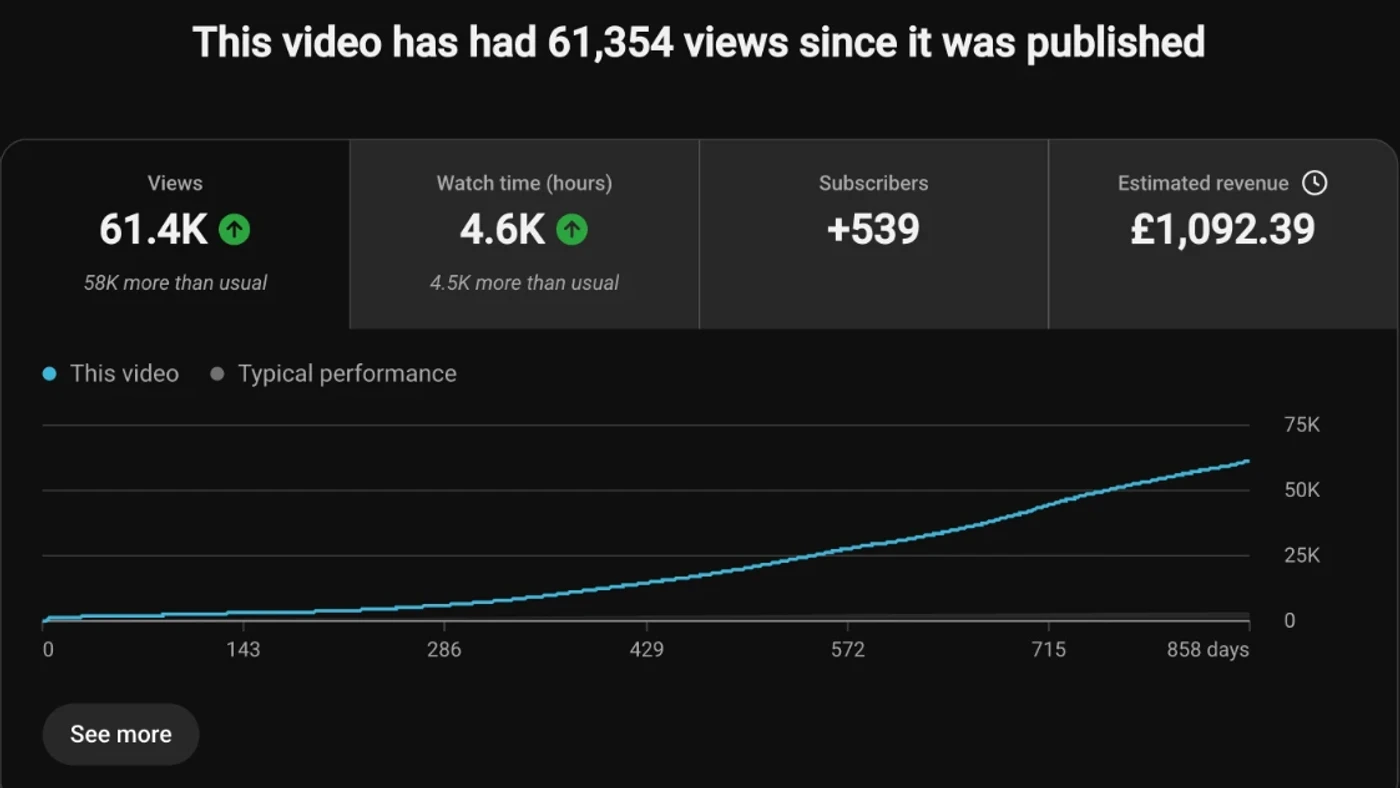
Look at the shape. It didn't spike and die. It built slowly, and the line gets steeper after the first year. The public counter showed 68,278 views on 2 November 2026, so it's still going. My Full Squarespace SEO Course did the same: 43.5K views, still climbing 798 days after publishing. Neither went viral. Each answered a question people kept typing into YouTube, and videos like those were part of how SEOSpace got to $100K a month with $0 spent on paid ads.
That's what evergreen content on YouTube means in practice. Virality is luck. A video built on a question people keep asking isn't.
What evergreen YouTube videos look like for a service business
Evergreen YouTube videos for a service business usually answer the question a buyer asks just before they pay someone: what does it cost, which option do I need, what should this person be doing for me. I searched a few of those topics with PreFilm and found the same pattern each time: plain explainers from small firms, years old, still well above their channel's normal.
The Estate Planning Guys, a law firm with 4,900 subscribers, posted "Will VS Living Trust: Which One Do You REALLY Need?" in March 2025. It's under eight minutes long. It has 8,641 views, which is 39.1× the channel's normal of 221.
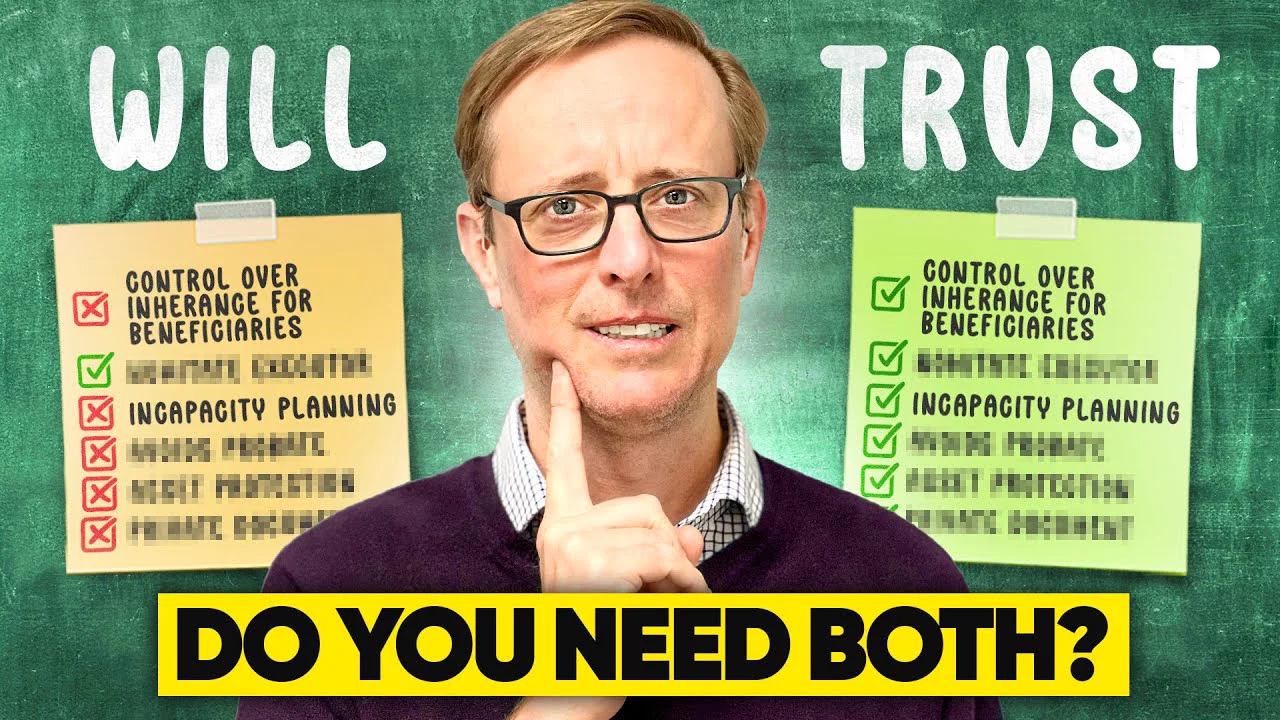
The title is the question, word for word. The video covers what a will doesn't do, what a trust does better, the cost of probate against the cost of a trust, and how to set one up. The description links to a page to book a discovery call. And the comments are people with real estate-planning problems, like one asking whether they can tap trust assets in an emergency. That's a viewer who might need a lawyer.
The CFO Report shows the series effect YouTube describes. "Fractional CFOs MUST Offer THESE Services!" went up in June 2022, and it opens as part two of a series and ends by teasing part three. It has 13,570 views, 7.6× the channel's normal of 1,796, on a channel with 9,190 subscribers.
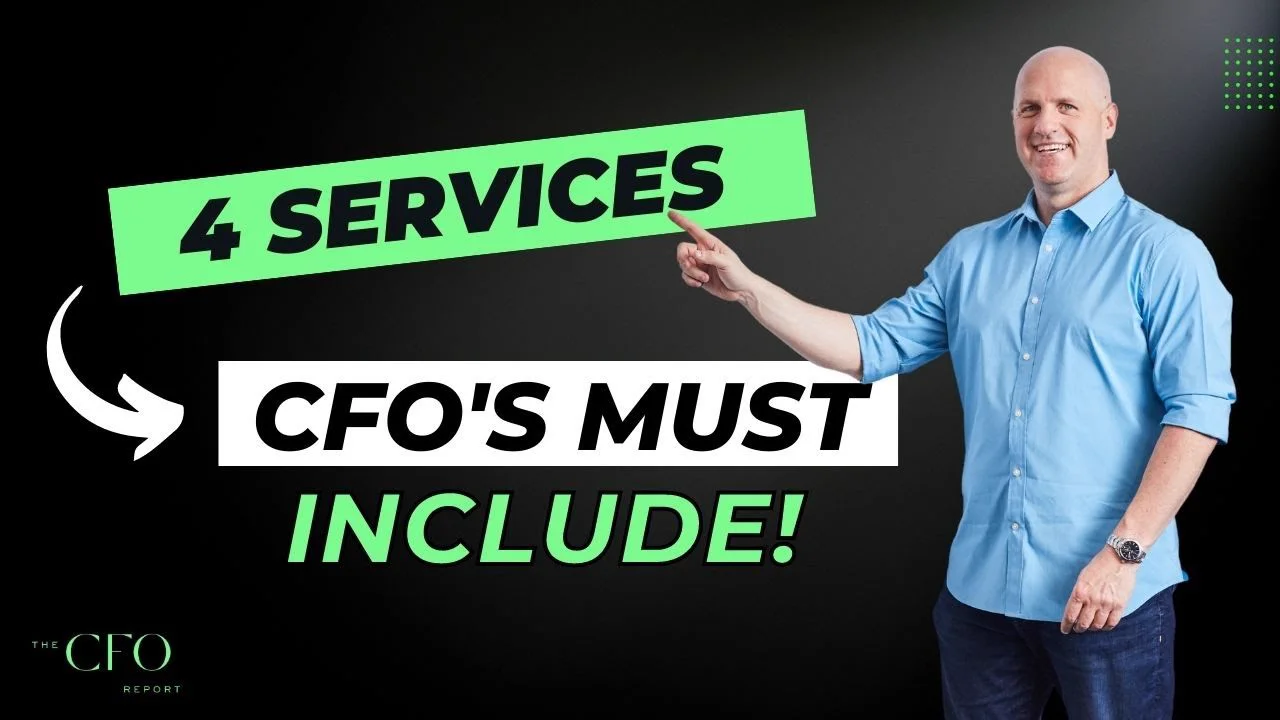
The detail I like most is in the description. The video is from 2022, but the link now points to a webinar registration from October 2025. The channel kept the old video working for its current offer. If you have an old video that still gets views, check where its description sends people.
Here are the four examples side by side, with their age on 2 November 2026:
| Video | Business | Age | Views | vs channel normal |
|---|---|---|---|---|
| Will VS Living Trust | Estate planning law firm | 600 days | 8,641 | 39.1× |
| Fractional CFOs MUST Offer THESE Services! | CFO coaching | 1,609 days | 13,570 | 7.6× |
| 10 Things your Fractional CFO should be doing for you | Clara CFO Group | 790 days | 10,871 | 9.1× |
| Small Kitchen Remodel Cost | Elisa Covington, property | 1,435 days | 49,799 | 8.7× |
Every one is a question or a cost. None depends on the news. And the kitchen video's comments ask for the same breakdown for bathrooms, windows and floors, which is the next evergreen video handed to the creator by the people who watched.
Find the topics that keep pulling in buyers
Find my winning videosDo browse hits work for a business too?
Browse hits work, but they come in waves rather than building steadily. Beaupré described this too: recommendations can come in "multiple waves", and a video can become relevant again months later to a different audience.
Cole Ferguson, a business broker with 7,030 subscribers, posted "4 Lessons Learned in 8 Years as a Business Broker" in January 2024. It got 4,034 views, 22.8× his channel's normal of 177.
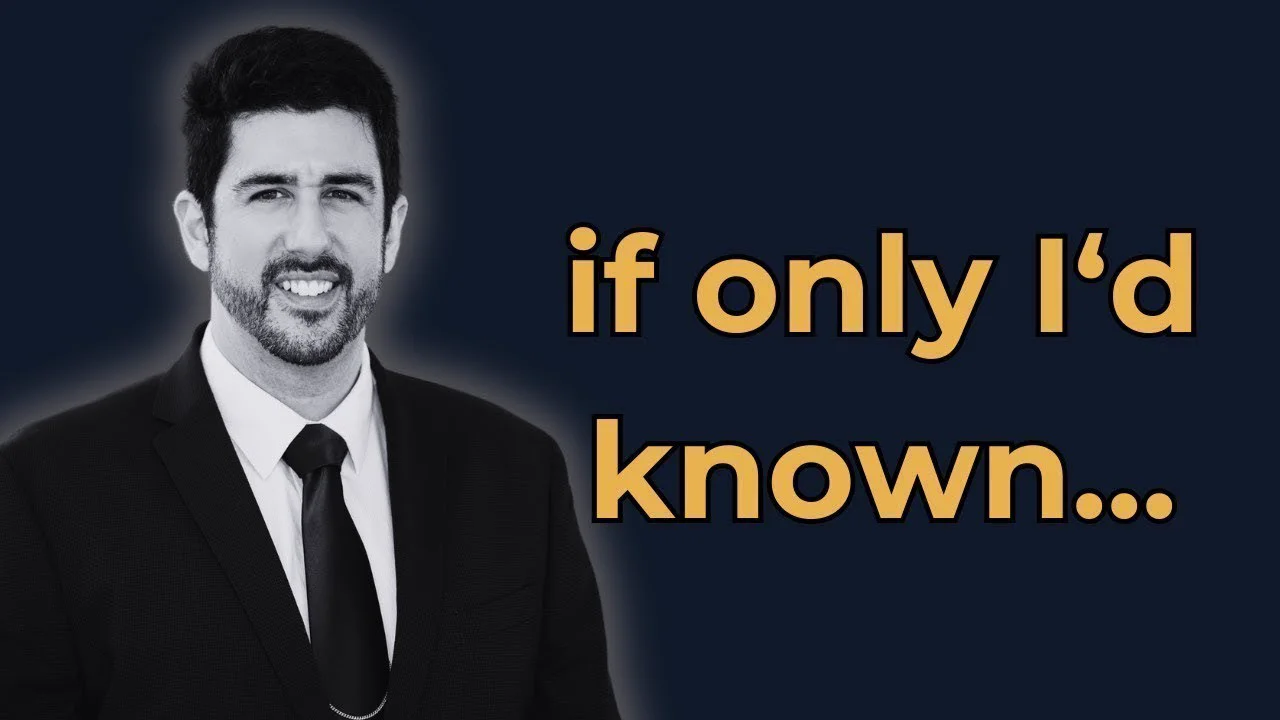
Nobody types "4 lessons learned in 8 years as a business broker" into YouTube. That title is built to be picked from a feed by someone who already watches this kind of video. It opens with "the number one lesson I wish I had known eight years ago", and the description offers a free business valuation. For a broker, that's a decent way to meet business owners who aren't searching yet.
So I'd use both. Search videos are the base that keeps growing. Browse videos reach people who don't know they need you yet. Just don't build your whole plan around browse hits, because you can't predict when the next wave comes.
What YouTube says doesn't matter
A lot of YouTube algorithm advice is myth, and YouTube has answered most of it directly. Here's what its performance FAQ says about the things creators worry about most:
- Posting every day. "Growth in views across uploads is not correlated with time between uploads."
- Taking a break. YouTube "studied thousands of channels that took a break and found no correlation between break length and changes in views". Your audience may take a little time to warm up again.
- The time you publish. "Publish time is not known to impact a video's long-term performance." It matters for live streams and Premieres.
- Tags. "Not important." They mainly help with common misspellings.
- Uploading as unlisted first. No, "what matters is how viewers respond after it's been published."
- Your channel's location setting. Not used for recommendations.
- Monetisation. The system "doesn't know which videos are monetizing and which are not."
- Changing a title or thumbnail. It can re-rank a video, but only because viewers respond to it differently. YouTube's advice: "don't change what's working."
And the big one: does a flop hurt your channel? YouTube says "what matters is how viewers reply to each video when it's recommended to them." Channel views drop when viewers stop watching most of your videos, not after one bad one.
I've had that flop. One of my videos got 102 views in about four months, and YouTube Studio marked it 78 views less than usual. It didn't sink the channel. The same channel later did 97,150 views in 28 days. The flop was a topic nobody wanted, and the fix was better topics, not a better upload schedule. I went through exactly what went wrong in how to get more views on YouTube.
How to make videos that keep growing
To make videos that keep growing, pick a question your buyers keep asking, check it has already worked for someone, and answer it so well that viewers are satisfied. Here's the order I'd do it in:
- List the questions buyers ask before they pay you. Cost, which option, what to expect. Those are searches that happen every day, whatever the news is doing.
- Check the topic has already beaten a channel's normal. An outlier is a video that got far more views than its channel normally gets. If small firms in your niche have outliers on the topic, the demand is real. PreFilm's video ideas finds those outliers in and around your niche and turns them into ideas for what you sell.
- Make the title the question. YouTube's FAQ asks for titles and thumbnails that "accurately represent the content", and warns that clickbait turns viewers away. The Estate Planning Guys' title is the search, and the video answers it.
- Get to the answer fast. Satisfaction is what YouTube measures. Check your audience retention graph for where people leave.
- Make it a series. YouTube lists a new video in a series as a reason old ones take off. Link episodes with playlists and end screens.
- Judge it over months, not hours. Beaupré said that even in the first hour, videos reach people who've never watched the channel. The first day tells you very little about an evergreen video.
- Fix packaging, not topics, on a video that's found but not clicked. If impressions are fine but clicks are low, try a new title or thumbnail with A/B testing in YouTube Studio.
- Keep old winners pointed at your current offer. Like The CFO Report, update the description link on any old video that still gets views.
How is the YouTube Shorts algorithm different?
The YouTube Shorts algorithm works on the same goal, satisfied viewers, but it measures them differently because people swipe through a feed instead of choosing a video. Todd Sherman, who leads Shorts at YouTube, said in a Creator Insider video on Shorts that "the audience is the algorithm" applies to Shorts too.
A few things he said that matter for a business:
- A new Short is shown to a seed audience first. Depending on how that goes, it gets more traffic or tapers off.
- Grabbing people in the first few seconds matters, whatever the length.
- Posting lots of low-quality Shorts doesn't trigger anything special. That effort is better spent on fewer, better videos.
- Don't delete a Short that didn't take off and repost it.
For most service businesses, I'd treat Shorts as a way to be seen and long videos as the thing that answers buyers' questions and keeps growing.
You don't need to beat the YouTube algorithm. It's trying to find the right video for each viewer, so give it a video your buyers genuinely want, on a question they'll still be asking in two years. If you want help finding those topics, see what PreFilm does or compare the plans. For the next step on growth, read how to grow a YouTube channel.
Stop guessing what to film.
PreFilm finds the videos your buyers already watch and writes the script in your voice. $1 for 7 days.
Find my winning videosQuestions
Questions.
What is the YouTube algorithm?
The YouTube algorithm is the recommendation and search system that decides which videos each viewer sees on Home, in Suggested videos and in search results. YouTube says it doesn't push videos to an audience. It finds the videos each viewer is most likely to watch and be satisfied with, based on what they and similar viewers do.
How does the YouTube algorithm work?
The YouTube algorithm works by ranking videos for each viewer at the moment they open YouTube. It learns from what they watch and don't watch, what they search for, likes, dislikes, Not interested feedback and satisfaction surveys. In search, it also checks how well the title, description and video content match what was typed.
Did the YouTube algorithm change in 2026?
The basics didn't change in 2026. In its September 2026 Creator Insider interview, YouTube still described a system that ranks videos for each viewer based on satisfaction and performance with similar viewers. YouTube's analytics help now says views are counted the moment a video starts to play, and in 2025 it applied large language models to recommendations.
Does the YouTube algorithm favour consistency?
No, not directly. YouTube's Help page says growth in views across uploads is not correlated with time between uploads, and that it found no correlation between break length and changes in views. A regular schedule can still help your audience build a habit, so post as often as you can keep the quality up.
Does the time you post affect the YouTube algorithm?
The time you post doesn't affect a video's long-term reach, according to YouTube. Its Help page says publish time is not known to impact long-term performance. Posting when your viewers are active can help early views, and timing matters more for live streams and Premieres, but a search video keeps getting found whatever hour it went live.
Will one bad video hurt my YouTube channel?
One bad video won't hurt your channel on its own. YouTube says what matters is how viewers respond to each video when it's recommended to them. Channel views drop when viewers stop watching most of your videos, not after a single flop. Check what went wrong, then pick the next topic from evidence.
What are evergreen videos on YouTube?
Evergreen videos on YouTube are videos that answer a question people keep asking, so they keep getting views for months or years after they're published. How-tos, cost breakdowns and explainers are typical. YouTube says a lot of videos get the majority of their views a month or more after publishing if they're evergreen.