Guides · 11 min read
How to grow a YouTube channel in 2026
If you want to know how to grow a YouTube channel, the short answer is to make videos people have already shown they want. That means formats that have beaten their channel's normal in your niche, and questions your buyers already type into YouTube search. Then make more of whatever works on your own channel.

I'm doing this on my own channel. Henry SaaS got 97,150 views in the 28 days from 25 September to 22 October 2026, more than ten times the 28 days before, on a channel of around 1,500 subscribers. And I don't use YouTube for views. I use it to get customers: more leads and more sales calls booked. So this guide is about channel growth that turns into business, with real examples from immigration lawyers, landscapers and physical therapy clinics.
What actually grows a YouTube channel?
A YouTube channel grows when new people watch its videos, and new people only arrive when YouTube shows your video to viewers who don't know you yet. You can see where your views come from in YouTube Studio, in the traffic sources report. Views from YouTube search, Browse features and Suggested videos are growth. Views from Channel pages and notifications are mostly people who already follow you.
So the real question is which videos will reach new people. You can't know for sure before you film, but you can stack the odds with evidence. There are three places to find it:
| Where the proof comes from | What it tells you | Where to look |
|---|---|---|
| Proven formats | People outside a channel's usual audience watched this kind of video | Videos beating their channel's normal in your niche |
| Search demand | People are typing this question into YouTube | YouTube's search predictions |
| Your own hits | Your audience wants more of this from you | Your Videos tab and YouTube Studio |
An outlier is a video that got far more views than its channel normally gets. The channel's normal is what a typical recent video on that channel gets. Divide a video's views by that normal and you get its multiplier, so a video at 10× did ten times better than usual. Subscriber counts don't come into it, which is exactly why outliers are useful for small channels.
What growth looks like on a 1,500-subscriber channel
Growth on a small channel comes in jumps, from a few videos that hit, not from every upload doing a little better. Here's the Videos tab of my channel, from the screen recording of my video ranking the YouTube tools I use.
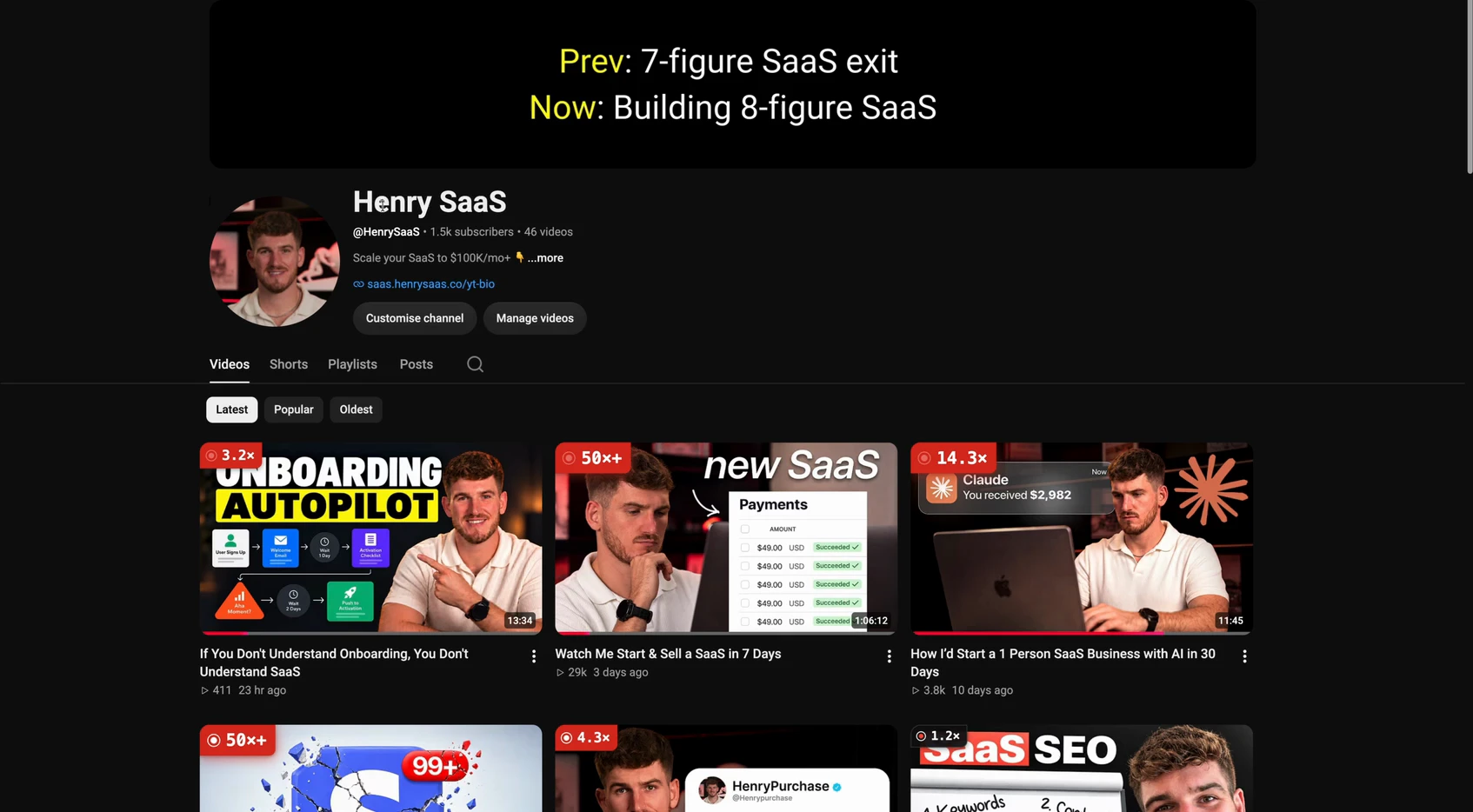
"Watch Me Start & Sell a SaaS in 7 Days" passed 29K views in three days. The red chips on each thumbnail come from PreFilm's Chrome extension, which shows each video's multiplier against its channel's normal, and that one reads 50×+.
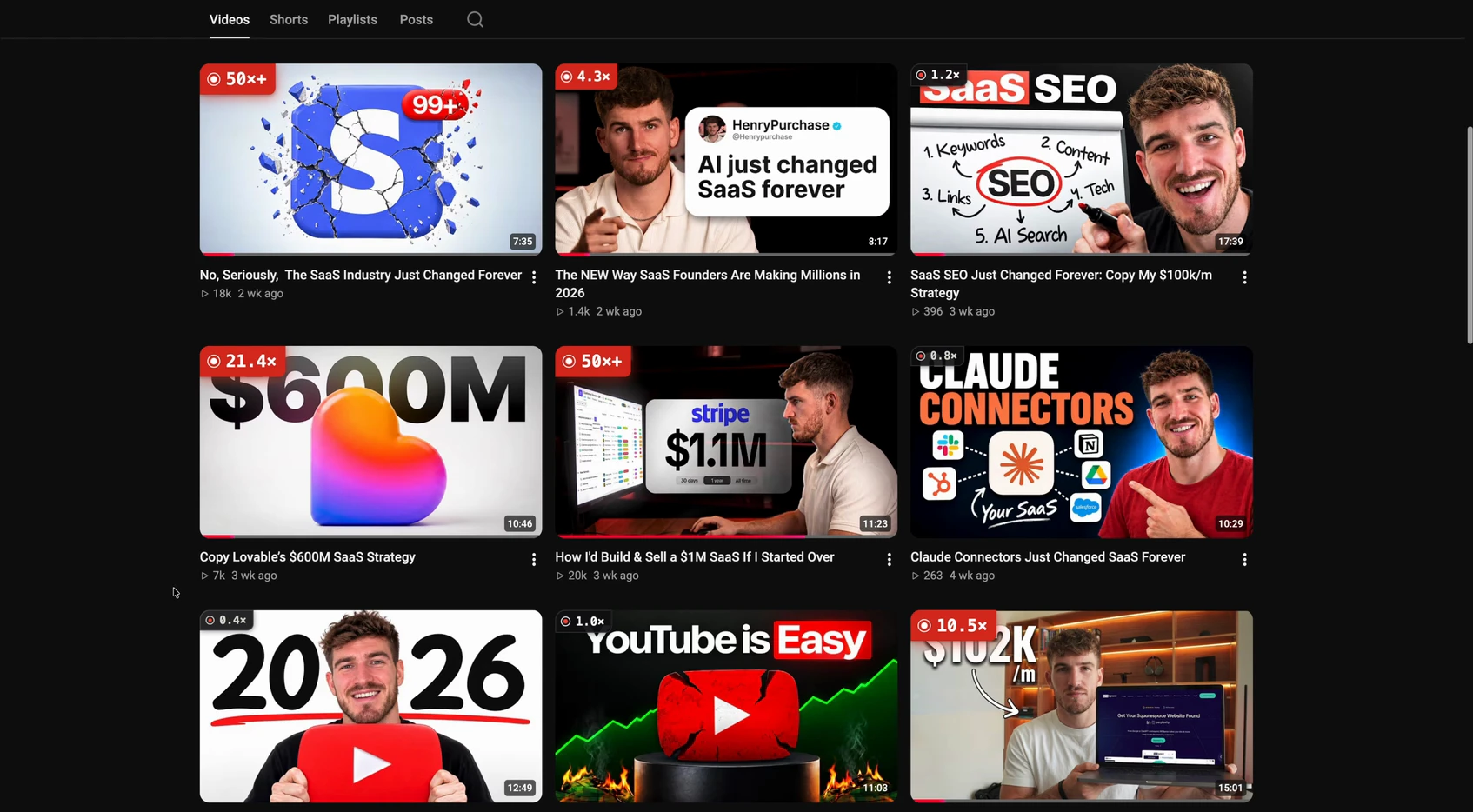
Scroll down and you'll see the pattern. "No, Seriously, The SaaS Industry Just Changed Forever" got 18K views. "How I'd Build & Sell a $1M SaaS If I Started Over" got 20K. "Copy Lovable's $600M SaaS Strategy" got 7K. In the same few weeks, a video on Claude connectors got 263 views and one on SaaS SEO got 396.
It was the same channel with the same subscribers in the same few weeks, so the channel's size didn't decide which videos grew it. The videos did.
The videos I made for my last company, SEOSpace, show the other side of growth: the slow, compounding kind. I chose those videos from search demand and proven formats before filming. "How to Use Google Search Console (for Beginners 2026)" reached 61.4K views and was still climbing 858 days after I published it. "Full Squarespace SEO Course (28+ Minutes)" reached 43.5K views and was still climbing after 798 days, and added 1K subscribers on its own. Videos like those were part of getting that company to $100K a month with $0 spent on paid ads.
Find the videos your buyers already watch
Find my winning videosHow to grow a YouTube channel with proven formats
A proven format is a type of video that keeps beating channels' normal, so when you make your own version, you start with the odds on your side. The strongest proof is a format that has won more than once, on more than one channel.
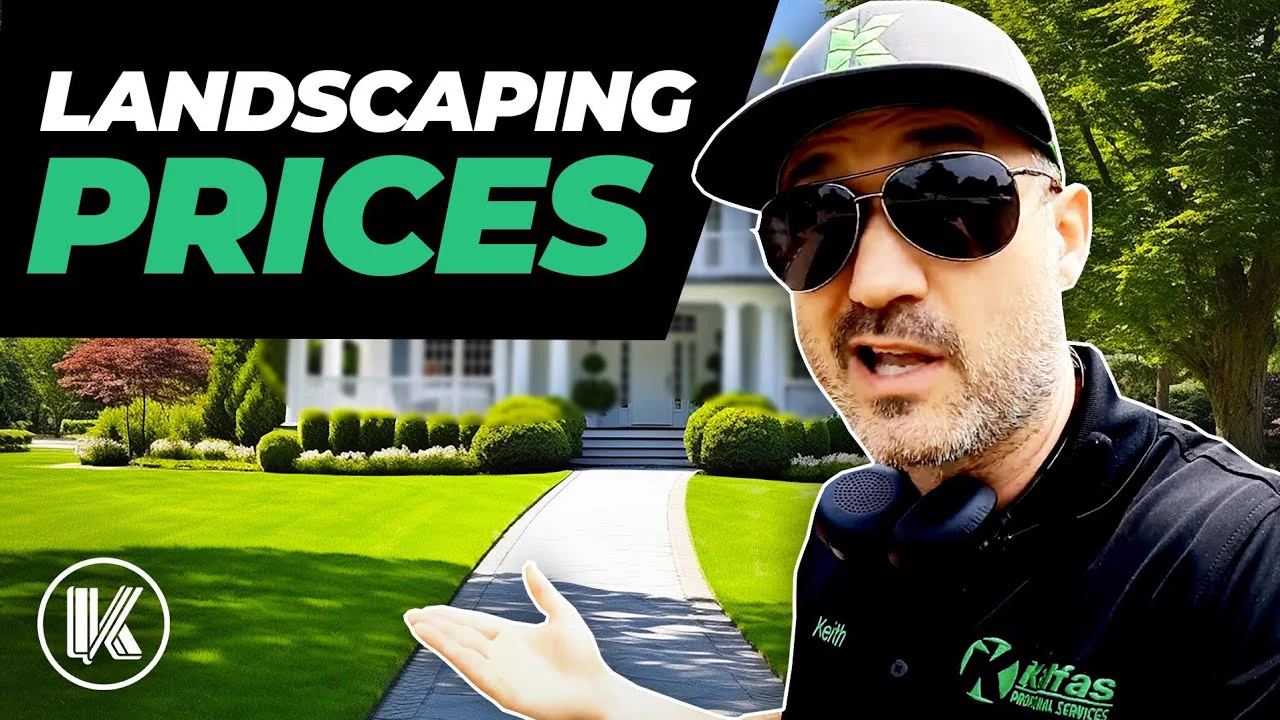
Keith Kalfas teaches landscapers how to run their business. His best format is pricing. "$1,700 Landscaping Job - Property Walk, Details, Pricing" got 79,973 views, 34.5× his channel's normal of 2,316. It's not a one-off. "How Much Should I Charge Hourly Landscaping Jobs?" got 8.7× his normal, and "How Much Does It Cost To Start a Landscaping Business" got 8.4×.
The same format works on other channels too. Florida Turf Pros posted "How I Priced Lawn Care Jobs as a Solo Operator (And Got Ahead!)" and got 68,696 views, 8.1× their normal. Two channels, the same question: what do I charge? That's a proven format.
And look at how Keith turns those views into business. He walks the property, does the maths on man-hours, mulch and stone, and lands on $1,700. Then, at 15:19, he offers a free marketing PDF that leads to his paid course. Even the comments hand him his next videos: viewers asked him to break down all the overheads of running the business, and to explain whether he quotes on site or later.
Formats travel across niches as well. PT Biz makes videos for physical therapists who want to start their own cash-based clinic, and has 4,260 subscribers. "How I'd Build a PT Clinic from Scratch (2025 Edition)" got 19.8× their normal. That's the same "if I started over" format as my own 20K video, in a completely different industry.

Here's how to find the formats that work in your niche:
- List the channels your buyers watch. Your competitors, and the channels next to yours. If you sell to clinic owners, include practice marketing and business coaching channels.
- Find each channel's normal. Look at its last 10 to 20 long videos and note what a typical one gets.
- Pick out the videos at 3× or more. Those are the topics that pulled in people the channel doesn't usually reach.
- Group them by format. Pricing breakdowns, "if I started over", day in the life, mistakes to avoid, a process explained. A format that shows up at 3× or more on two or three channels is the one to make.
- Make it about your offer. Keep the format and change the subject to what you sell. A landscaper's pricing walk-through becomes a bookkeeper's "what I'd charge for this client", or a lawyer's "what this case actually costs".
Doing this by hand takes a while. PreFilm's video ideas do it for you: they find the outliers in and around your niche and turn them into ideas for what you sell, each showing the video it came from and how far it beat its channel's normal.
How to grow on YouTube from search demand
Search is the most reliable way to grow on YouTube when your channel is small, because people looking for an answer will watch whoever answers it, however many subscribers they have. And a search video keeps getting found long after you post it.
Passage Immigration Law has 5,960 subscribers. Their video "E2 Visa Secrets: How to Work in the U.S. Without Investing $100K" got 13,576 views, 7.7× their normal of 1,759. It's four minutes long. The first line restates the viewer's problem: there's a part of the E-2 visa many people don't know about, and it helps if you don't have the money to qualify as an investor.

Then it answers the question and asks for the business. At 3:38 the attorney invites viewers to call, text or visit the firm's website to book a consultation. That's what a search video for a service business looks like: answer the question properly, then offer the next step to the people who need more help. And the comments asked which countries have E-2 treaties with the US. That's the next search video, written by the viewers.
Small numbers count too. Paul Gough runs a physical therapy marketing channel with 1,610 subscribers. "How to Get More Patients for My PT Clinic" has 1,510 views, 26.5× his normal. That isn't a big number. But almost everyone who clicks a title like that is a clinic owner who wants more patients, which is exactly who a physical therapy marketing channel is for.
To find searches worth answering:
- Type your topic into YouTube and read the search predictions that drop down. Those are phrases real people type.
- Read the comments under your competitors' best videos. Questions people ask there are often questions they also search.
- Put the searcher's own wording in your title, and answer the question in the first 30 seconds.
There's more on titles, descriptions and search in YouTube SEO in 2026.
Find the formats your buyers already watch
Find my winning videosA YouTube growth strategy for business owners
A YouTube growth strategy for a business is simple: one well-chosen video a week, each backed by proof, measured by the leads it brings in rather than its views. Here's how I'd run it.
- Write down who buys from you and what they ask before they buy. Those questions are your search videos. Your sales calls and inbox are full of them.
- Alternate formats and searches. One week, a proven format from your niche. The next, an answer to a question your buyers search for.
- Write the title before you film. If you can't write a title that says who it's for and what they get, the idea isn't ready.
- Check each video against your own normal after 30 days. In YouTube Studio, compare its views with your typical video, and check the traffic sources to see whether YouTube search or Browse features brought in new viewers.
- Make a follow-up to anything well above your normal. A hit tells you what your audience wants more of. Keith Kalfas didn't make one pricing video. He made several.
- Track leads, not just views. Put one clear next step in every video and its description, and count the calls and enquiries that come from it.
That last point is the one most growth advice skips. As I said in my vidIQ alternatives video, I don't care about how many views or subscribers I have. I care about making money from YouTube. A video watched by 1,500 clinic owners is worth more to a business that sells to clinic owners than 100,000 views from people who will never buy. For how YouTube decides who sees each video, read how the YouTube algorithm picks videos.
How to grow a YouTube channel from zero
If you're starting from zero, start with search, because nobody is waiting for your uploads yet but people are already searching for answers. Your first five to ten videos should each answer one question your buyers ask before they buy.
Don't worry about having no outliers of your own yet. You can still study other channels in your niche, and the free tools and the PreFilm blog cover the basics without costing anything. Use YouTube Studio to see what each video does, and make more of whatever gets found.
I'll be honest about where PreFilm fits. It works best once you've published a few videos, because it learns what you sell and how you talk from your past uploads. As I said in that tools video, if you're new to YouTube, PreFilm isn't for you yet. Get a few videos out first.
On money: YouTube's ads need 1,000 subscribers before you can earn from them. The YouTube Partner Program asks for 1,000 subscribers with 4,000 watch hours in the last 12 months, or 10 million Shorts views in the last 90 days. A business doesn't need to wait for that, because its money comes from the customers a video brings in, not the ads shown on it.
How long does it take to grow a YouTube channel?
It takes as long as it takes to publish a video that the right people want, which is why picking topics matters more than putting in the months. There's no reliable average, and any number you read is a guess about someone else's channel.
What the examples above show is that size isn't the barrier. Paul Gough got 26.5× his normal on 1,610 subscribers. Passage Immigration Law got 7.7× on 5,960. My channel had videos pass 20K views at about 1,500 subscribers.
And search videos compound. My Google Search Console tutorial was still climbing 858 days after I published it. A video like that keeps bringing in viewers, and customers, while you make the next one. If your views are stuck, how to get more views on YouTube shows how to find which number is holding a video back.
What I'd skip
Some common YouTube growth advice won't bring you the right viewers, and some can hurt your channel.
- Buying subscribers or views. YouTube's fake engagement policy bans services that artificially inflate numbers, and fake viewers never become customers.
- Chasing viral trends. Virality is luck. Data is not. A trend that has nothing to do with your offer brings in viewers who will never buy.
- Posting more for its own sake. Three rushed videos that nobody searches for do less than one video with proof behind it.
If you want to compare the tools that help with this research, I ranked them in the best YouTube tools for business owners.
Pick your next video from proof, not a hunch: a format that has already beaten its channel's normal, or a question your buyers already search for. Then watch which of your own videos jump, and make more of those. If you'd like the research done for you, see what PreFilm does or compare the plans.
Stop guessing what to film.
PreFilm finds the videos your buyers already watch and writes the script in your voice. $1 for 7 days.
Find my winning videosQuestions
Questions.
How do I grow my YouTube channel?
Grow your YouTube channel by making videos that already have proof behind them. Look for videos beating their channel's normal in your niche, and for questions your buyers type into YouTube search. Then check which of your own uploads beat your normal, and make more videos like those instead of guessing.
How to grow a YouTube channel fast?
The fastest way to grow a YouTube channel is to copy what's already working in your niche, then make it specific to your buyers. A format that has beaten several channels' normal is far more likely to work for you than a fresh idea. Speed comes from fewer misses, not from posting more often.
How long does it take to grow a YouTube channel?
It takes as long as it takes to publish a video people want, which is why topic choice matters more than time. Small channels get outliers all the time. A physical therapy marketing channel with 1,610 subscribers got 26.5 times its normal views on one video. Good search videos then keep growing for years.
How to grow a YouTube channel from 0 subscribers?
Start with search. With 0 subscribers, nobody is waiting for your uploads, but people are already searching for answers. Make your first videos answer the exact questions your buyers ask before they buy, put their wording in the title, and get to the answer quickly. Then make more of whatever gets found.
How many subscribers do you need to make money on YouTube?
You need 1,000 subscribers to earn from ads through the YouTube Partner Program, plus 4,000 watch hours in 12 months or 10 million Shorts views in 90 days. A business can make money from YouTube long before that, though, because its money comes from the customers its videos bring in, not from ads.
Is it too late to start a YouTube channel in 2026?
No, it isn't too late to start a YouTube channel in 2026. YouTube judges each video on whether viewers want it, not on how old the channel is. An immigration law firm with 5,960 subscribers got 13,576 views on one explainer, and my own channel of about 1,500 subscribers had videos pass 20,000 views.